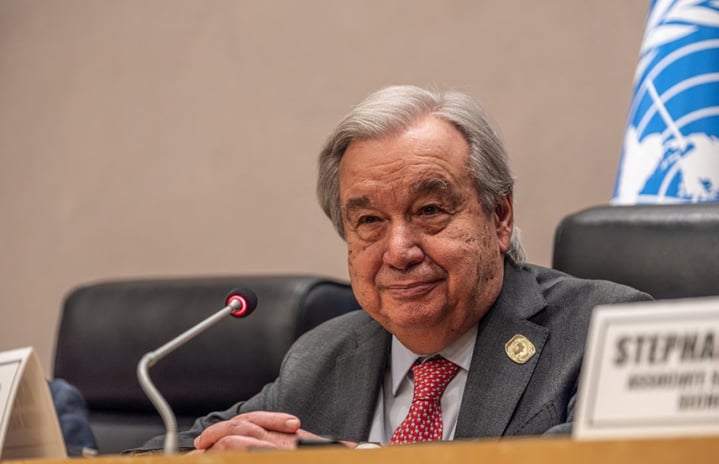
UN Secretary-General Antonio Guterres has launched an interagency task force to help secure the passage of fertilizers through the Strait of Hormuz, his spokesperson announced on Friday.
"As the conflict in the Middle East unfolds and threatens to intensify, disruptions in maritime trade through the Strait of Hormuz risk creating ripple effects impacting humanitarian needs and agricultural production in the coming months," Stephane Dujarric said. "Immediate action is essential to mitigate these consequences."
The "dedicated task force" will work to "develop and propose technical mechanisms," that will "facilitate fertilizer trade, including the movement of related raw materials" through the strait.
The group includes representatives from several international agencies and will work "in close consultation" with relevant UN member states.
Dujarric noted that the secretary-general had phone calls in recent days with representatives of Iran, the United States, Pakistan, Egypt and Bahrain.
"We have a lot of experience on kind of these types of mechanisms in conflict zones," he said while referencing an agreement that allowed Ukrainian grain to transit the Black Sea for a little over a year after Russia's invasion of Ukraine.
The establishment of the task force comes as the planting season -- which will require fertilizer -- is about to begin in many of the world's major agricultural regions.
According to the UN Food and Agriculture Organization (FAO), up to 30 percent of international fertilizer trade passes through the Strait of Hormuz.
On Thursday, FAO chief economist Maximo Torero estimated that if the war were to continue for another week or two, markets could "absorb" the shock.
If the conflict lasts more than a month, "the picture changes," he said.
"The medium-term scenario of a three-month blockade will affect all farmers globally," he warned, predicting a subsequent drop in wheat, rice, and corn harvests.
© Agence France-Presse